B
Title: Midsummer Magic
Author: Catherine Coulter
Publication Info: Onyx 1987
ISBN: 0451402049
Genre: Historical: European


Consider the description on the back of my copy:
Clever, Beautiful Frances Kilbracken disguised herself as a mousy Scottish lass to keep Hawk, the…dashing Earl of Rothermere from being forced to marry her. But she was chosen as his bride for that very reasons. Wedded, bedded, and finally deserted, Frances quickly shed her dowdy facade to become glittering London’s most ravishing and fashionable leading lady.
And even the 2000 Reed Business info quoted on the Amazon.com page:
Good beach reading, Coulter’s 1987 historical romance finds the beauteous and brainy Frances Kilbracken forced into marriage with the roguish Hawk (yes, I did say, Hawk). After fulfilling his conquest of Frances, Hawk abandons her and is smitten by a mystery woman, who actually is guess who?
*le sigh*
Frances never goes to London. She’s either in Scotland, or at the Rothermere country estate, which is fifteen miles from York. Forgive my ever-dependable lack of UK geographical knowledge, but York is a mighty ways away from London, and I think the farthest Frances and Hawk travel during their marriage is to Newmarket, which is still some distance from London by carriage. Frances is never in London as a “leading lady” and while she is fashionable and ravishing, she hasn’t snuck into the ton to reveal herself. She’s still near York most of the time.
Moreover, while Frances does disguise herself as a dowdy mouse to avoid Hawk’s interest, when she returns to her normal, beautiful state, he knows exactly who she is, and is absolutely furious about the transformation and the deception.
The cover copy alone is ample evidence of what was wrong with romance covers back in the day – my copy was published in 1987, I believe – but then, consider the cover image itself:
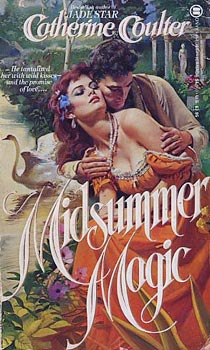
We’ve snarked this cover hard, as it is one of the more fabulous examples of “Invisible Buttsecks” covers in romance history – not to mention the dubious decision to put a red-haired woman in an orange dress while wearing silver and turquoise eyeshadow. Also, did he just fart out a swan?!
But behind (hur hur) the cover, there lies one of my favorite old-school romances. And when I mentioned it last week as part of a larger discussion of alpha males, I realized that it’s been so long since I read this book that it might be time to revisit it, just in case my memory is faulty as usual, only this time instead of giving me a total blank, my doofy memory has added a patina of quality that the original book didn’t have.
Nope, my memory and I are in accord: the book is still marvelously good, despite the misleading cover copy, the cover image, and some of the worst typesetting errors sprinkled throughout the entire book. Typos, missing quotations, missing capital letters – Jesus Flapjack, who typeset this thing?! Even with all these distractions, I still love this book, and it’s not just the sentimental value talking.
Frances Kilbracken is one of three Scottish sisters whose father, Earl of Ruthven, made a pact with the Marquess of Chandos some years before. Seems Ruthven saved Chandos’ life, and Chandos promised to marry one of his sons to one of Ruthven’s daughters. When Chandos suddenly takes ill, he asks his heir, Phillip (more commonly known as Hawk – yes, of course he has to have a nickname of a predatory bird. This is old school romance after all!) to go on up to Scotland and marry one of the daughters, completing his oath to Ruthven.
Hawk is not at all pleased with this idea. He recently inherited the title at the sudden death of his brother, Nevil, and has been enjoying his new life. Instead of a soldier in Wellington’s army, he’s a Lord of the realm, complete with amorous mistress, neverending nightlife in London, and a healthy amount of wealth to his name.
Frances thinks the entire idea is barbaric, and when she hears of Hawk’s life in London, she figures he’d want a wife as festive, gay, entertaining, and social as the women he currently spends time with. So Frances turns herself into a dowdy, frumpy, socially inept sourpuss and tries to drive Hawk away.
Trouble is, Hawk figures that if he marries Frances, dumps her in the country and heads on back to London, his life can continue as it was, and he won’t have to change a thing.
Consider the multitude of plot elements that could go horribly wrong with this setup: the foundation of the relationship is essentially a Big Misunderstanding. Both parties are horribly blind to one another, plus there’s the aspect of sex between the unwilling protagonists to deal with. But Coulter balances out these tricky elements admirably, and this is still one of my very favorite old school romances.
First: the hero. Yes, the hero forces Frances to have sex with him. This is indeed the romance wherein he has to use cream to ease his way up her tender virgin passage because she wants nothing to do with him, but he has a responsibility to beget an heir, and she’s half the equation required for that result. She knows it, he knows it, and so she lies still, tries to hide from him at times, but submits to his passionless ministrations.
But Coulter’s master stroke (har har) in creating empathy for Hawk is in the first chapter: Hawk rushes from London because he is told his father is dying. The entire chapter reveals how much Hawk cares for his parent, how unwilling he is to live up to an oath he didn’t make, and how, despite that unwillingness, he is aware of the responsibilities of his new life as Earl of Rothermere. In 16 pages of writing, Coulter establishes a hero who is noble, caring, dedicated to his family and his role as heir to the title, and empathetic – because who hasn’t had to do something they really, really did not want to do?
Second: the heroine. Frances is headstrong, intelligent, clever, and utterly hoisted by her own petard. Hawk is gorgeous and she is undeniably attracted to him, but she doesn’t want to marry him, nor does she want to leave Scotland. She doesn’t want her life to change any more than Hawk wants to give up his social life in London.
Yes, there are parts that made me dog-ear a page and laugh out loud, such as Frances’ completely incongruous need for “something more” in her life:
“I want to marry a rich man. I want to be somebody. What else can a woman look forward to anyway?” Viola said.
That was perfectly true, of course, Frances thought, suddenly depressed, but it wasn’t fair. She repeated her thought aloud. “It’s not fair. We should be able to do anything we wish to do.”
I can hear the music from Mary Poppins now: No more the meek and mild subservients we! We’re fighting for our rights, militantly! Well done! Sister Suffragette! Frances at times is a blooming ludicrous example of contemporary mentality shoved into an historical heroine. Even with all that posturing, I like her anyway.
There are some other flaws to the writing, such as an incredible propensity toward head hopping, like the narrator is a Jack Russell terrier on amphetamines. And there is also some marvelously purple prose, plus one of my very, very favorite phrases in all of romance to describe female arousal: To her utter consternation, Frances felt a deep spurt of something very warm and urgent between her thighs.
Now, between you and me? If I feel that, it probably means my water broke. But for Frances? Her arousal “spurts” a few times here and there through the book. It’s enough to make you want to send a gyn back in time to help her out with that problem.
By far the largest topic to discuss regarding this novel: the sex scenes where Frances lies still, an unwilling partner, as Hawk does his best to cause conception as quickly and painlessly as possible. This is one of the few romances I’ve read that has multiple scenes that depict what sexual intercourse could have been like for a couple that wasn’t sexually interested in or even friends with one another. It’s a duty and an obligation, and it’s disturbing, but in this case, the process reveals a good deal about each character. Hawk will rise (har har) to his responsibilities, even if they make him lonely and sad, and Frances will acquiesce to her own duties, even if they also make her lonely and sad.
Hawk, of course, has friends and a very passionate mistress. Frances is in a new place with no one she knows, forced to make a new life for herself despite her best efforts. Frances was caught in her own trap, and in the end, only by revealing who she really is can she find happiness. The same, of course, is true for the hero. He doesn’t enjoy the passionless sex that is his marital duty, and only by admitting he too longs for “something more” between his wife and himself can he find happiness.
Pamela Regis, in her book A Natural History of the Romance Novel outlines the primary differences between what Candy and I call “Old School” and “New School” romance. One of them, and the one I find most interesting, is the requirement in “New School” romance that the hero make his own journey to become worthy of the happy ending. Despite Midsummer Magic bearing many of the hallmarks of “Old School” romance, Hawk evolves through the story into a hero worthy of Frances and worthy of their happy ending. He wasn’t a complete buttmonkey to start with, either – he started from a place of some established empathy: he thought his father was dying and had to honor his wishes – and evolves to a place of greater heroism: he finds a purpose in life, a suitable vocation he can indulge in with his spouse, and a path toward leaving a greater inheritance for his children. And on top of that, he finds a passionate and unique relationship with his wife. They were forced to marry, but as they reveal their true characters, they find that, as is proper in a romance novel, they are perfectly matched.

I wonder if they did that cover at the same time as this one: http://tinyurl.com/26edlu
I have a perverse fondness for those late 80s covers. Like this one, which perhaps uses at least the same female model?: http://tinyurl.com/yomgk3
Is this the book where the chick spies on him taking a bath/shower in a waterfall before going inside to dull herself down?
” a Jack Russell terrier on amphetamines”
OMG! Sarah, that’s a truly frightening mental picture! And you should be ashamed of your bad puns! Oh, don’t mind me, I’m just jealous of your punning talent. And your writing ability.
pay52: No way! I’ve never paid for it, or accepted $ either! (And yes, was offered $ once.) And I’m younger than that. Really.
No, there’s no waterfall. She does spy him climbing out of an ice-cold loch before he arrives at her home, and sees his Little Hawk all naked and cold, but she doesn’t dull herself down. Frances, like many an old-school heroine, is informed about how farm animals get it on, but never herself considered that humans, like her, ‘are just nothing but mammals so they should do it like they do on the Discovery channel.’
And Smartmensabitch – thank you. That’s a really nice compliment. You rule.
Damn, you rock. This was not the first romance, nor CC, I read, and it took me a while to realize that yes, I had read it when I gorged myself on her books. It was the cold cream up the hoo-hah comment that reminded me. But did you have to give me dueling earworms with those two song references?
Thank you thank you thank you for reviewing one of my all-time favorite Catherine Coulter’s 🙂
Thanks Sarah. Now when is the Sweet Valley High review/contest winner announcement coming?
That would be tomorrow – Mwaaahahahahahaha.
Um, by “dull herself down” I meant put on a grey dress, skin her hair back, etc. Even though there’s no waterfall, I’ve got a niggling feeling I’ve read it before….I might have to see if the used bookstore has it.
Sarah, I don’t recall that bit in Regis. Do you have a page reference for it? I do remember her making a distinction between the heroes of classic (i.e. Greek and Roman) comedy and the heroes of modern romances, and she then distinguishes between modern heroes who need to be tamed and those who need to be healed:
twentieth-century popular romance novels are still comedies, but the expression of the societal disorder (with which all comedies begin) is largely within the heroine and hero themselves, and the twentieth-century hero makes the largest new contribution to this kind of disorder and to its being made orderly by the betrothal at the end of the work. Ordering society is now an issue of taming or healing the hero. (114)
However, when Regis is contrasting the dangerous alpha hero who needs to be tamed with the sentimental hero who needs to be healed, she uses Pamela, Pride and Prejudice and Jane Eyre as examples of heroes who needed to be tamed and contrasts them with George, the sentimental hero of A Room with a View, who needs to be healed.
I have the impression, though, that none of these works would count as either “New School” or “Old School”, if Coulter is “Old School”. Maybe I’m misunderstanding the terminology you’re using, or maybe I haven’t found the right bit of Regis’ book.
I’ve noticed people using the terms “Old School” and “New School” before, and I’m not entirely sure what they mean, though I’ve had the vague impression that “Old School” was more likely to include rapist heroes. But in that case “Old School” wouldn’t include Heyer, so I’m puzzled. What makes some romances “Old” and others “New”?
Somehow, I think I missed this one. Hard to believe but there you have it. Wonder if I can download it for my reader? (Buying books for my Sony Reader has *so* many advantages: no shelf space in the house to take up and hubby has *no* idea how much I’m spending on books. After all, they’re not piled all around the house and all he sees me with is the Reader, not books with different covers…)
Deb, I searched Fictionwise but didn’t find this one…will have to hunt it down in s/h bookshops instead I think. To be lazy, I searched “Coulter” but, fuck me, it displayed Ann as well as Catherine.
Ann Coulter! OMFG. I think I need a lie-down. And some memory repression therapy. And a couple of stiff whiskies. Does anyone have any chocolate?
LMAO. I loved this book. Catherine Coulter was my first romance author as well, so I have a soft spot for her novels. They always make me laugh.
Wow- so this is a book I read last summer in Africa, due to a not very well provisioned library and a desperation to read a romance after months of deprivation. And I remember it so much different than you…I found it deeply disturbing. I remember the sex scenes as not being her laying still and suffering through it to do her duty, but multiple rapes where he forces her despite her pleading and crying, and even once attempting to run away from him during the act. In fact, he was in no way sympathetic to me through the entire book, and never appologized or attempted to woo his wife.
To me, this romance novel is a great example of what I find so wrong about this genre (although I do still desperately search for those few writers who write outside the box, as it were). How is it that so many of these books, then and now, are so deeply sexist, violent, and unrealistic, and yet are written by women? Why are we still promoting the bullshit about virgins/rakes, rape, and down right abusive relationships as romance? Gahhh!!
Sounds like a good story – I’m going to track down a copy now.
To her utter consternation, Frances felt a deep spurt of something very warm and urgent between her thighs.
When I read this line, I thought she’d coughed and suffered stress incontinence. Get that woman some Depends! 🙂
Maddy wrote: I remember the sex scenes as not being her laying still and suffering through it to do her duty, but multiple rapes where he forces her despite her pleading and crying, and even once attempting to run away from him during the act. In fact, he was in no way sympathetic to me through the entire book, and never appologized or attempted to woo his wife.
I’m rather fascinated at how my impressions are so different from yours. Frances definitely has to lie still and “do her duty,” and she does hide from him once before he figures out where she’s hiding.
But as I was writing in both this review and in the thread about “Alphas in Marriage,” in this specific instance, Hawk, in my opinion, had already been established as not-your-average-Alpha-male-jackass hero. The first chapter is all about him and his father, and his attempts to live up to his responsibilities as Earl, responsibilities he never expected to have. Moreover, Frances is caught in her own trap and ends up married to Hawk despite her best efforts.
Both parties are aware of the responsibilities of marriage at that time, and it’s not like Hawk brutalizes her. There is, as I’ve mentioned, a lot of cream involved (yet another reason to send back in time some gyn assistance for this poor woman.)
Hawk is not getting off on her unwillingness, nor is he enjoying it. He’s not having sex with Frances to force her to his will or prove a point. He’s trying to live up to his marital duty and that is a fine line in my perspective between this character and other “heroes” in historical romances published at that time and earlier, who brutalize their partners to “tame” or “gentle” them to their will.
As for your assertion that he doesn’t apologize or attempt to woo his wife, I disagree there. He never says the words “I’m sorry.”. He does, however, go to his mistress once he’s back in London, and tells her about his problems. Then, holy cannoli, he listens to her when she tells him she has his head up his ass, and listens to her again when she tells him what to do to seduce his wife. He gets mad and pouty because his mistress shouldn’t be telling him to go woo his wife, but he does go back up to York and try to repair what happened before.
And even outside of sexual matters, Hawk realizes that the stud and racing stables at his estate mean a great deal to Frances, and while he’d been considering selling them, he changes his mind once he recognizes that the stables, the stud, and the racing prospects make Frances very, very happy. He chooses to make his wife happy, and while there is no revealing moment of “Everything I do, I do for you” *cue Robin Hood Soundtrack* he does reveal himself in myriad little ways.
Coulter’s contemporaries and suspense novels are not my favorite because of her heavy-handed angst and slow-moving clumsy plots, but this historical is a marvelous example of how a hero can be redeemed subtly and thoroughly, even without big confessions of love and ardor. Hawk has to come to respect Frances as he gets to know her after their marriage, and vice versa, and that process is just as heady for me as the parts where they reveal their feelings.