B-
Title: Not Quite a Lady
Author: Loretta Chase
Publication Info: Avon 2007
ISBN: 0061231231
Genre: Historical: European
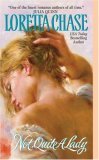

1 aristocratic female, used once and discarded
1 scientifically-minded, commitment-phobic male
1 heartless rake
1 doting stepmama
1 doting father, adorably clueless
1 daunting, autocratic father
1 rival for heroine’s affections in the form of a tall, dark and handsome colonel
1 secret baby
2 tablespoons matchmaking efforts
1-1/2 cups unlikely coincidence
1 large stick romantic tension
1 cup witty banter
3 gallons guilt and self-recrimination
2 cups unlikely ending
1 giant red bow, velvet or satin preferred
Instructions:
1. Pre-prep: Take aristocratic female and combine with heartless rake, then lightly kill rake. Incubate secret baby for nine months, then remove from female and (via doting stepmama) spirit away to the North for later use. Insert in baby’s place 3 gallons guilt and self-recrimination; occasionally add presence of doting father to bring guilt to a gentle simmer. Let heroine stew for several years.
2. Take autocratic hero’s father and combine with matchmaking efforts. Send hero to ramshackle estate.
3. Bring hero into heroine’s presence and agitate gently. Add witty banter as necessary.
4. Beat hero and heroine with romantic tension until well-muddled. Add a good dash of rival to speed up the process.
5. Combine hero and heroine in laundry room.
6. Throw in unlikely coincidence into the mix and stir at high speed. Unlikely coincidence will bring conflict to a brisk boil and make the reviewer go “Dammit, I HATE it when I’m right about these sorts of deathly predictable things.”
7. Remove cluelessness from father. Briefly increase guilt on heroine’s part, then drain away and replace with now no-longer-very-secret child. Unite hero, heroine and child.
8. Douse mixture liberally with unlikely ending; allow to soak for two minutes and pour into a bowl. Cover bowl and tie everything together neatly with giant red bow.
Loretta Chase once wrote in Lord of Scoundrels: “In my dictionary, romance is not maudlin, treacly sentiment. It is a curry, spiced with excitement and humor and a healthy dollop of cynicism.”
As far as definitions go for romance, that’s an excellent one, and I’d say Loretta Chase herself has been one of the best at writing novels that live up to that adage. In fact, there are only two books of hers that aren’t on my keeper shelf: the alternately brilliant and atrocious The Last Hellion (alas, the atrocious bits outweighed the brilliance), and Not Quite a Lady.
So, not that I want to get inappropriately personal or anything, but: Loretta. Dude. What happened?
Lookit, this book not only features a secret baby, but a secret baby that’s reunited with the heroine by a string of highly unlikely circumstances, AND it features an ending that smooths over the difficulties and minimizes the impact of what happened. I’m not talking about the social consequences—though that was handled in a rather distressingly facile manner as well—but the emotional impact on the family. From the father (who’s been lied to for over ten years not just by his beloved daughter, but by his wife), to the child himself—come on, the boy’s concept of who he was and where he came from has proven to be a complete and utter lie—the book dealt with all that juicy conflict in the space of a couple dozen pages. Double you tee eff, mate?
Let’s face it, the secret baby device is pretty damn hackneyed, even when done well—and I speak this as somebody who’s actually enjoyed secret baby books in the past, despite my tendency to treat it like a piñata—so why exacerbate it by making everything so pat? So easy? So—dare I say it—treacly?
It’s not as if I’m especially bothered by predictability or spoilers; in fact, I’m the sort of sick freak who’ll occasionally sneak a peek at the ending of a book and continue happily reading. But once the secret baby was introduced, I had a sinking feeling in my stomach that the kid was going to show up later in the book, probably as a plot device to allow things to come to a head.
I didn’t especially enjoy being proven right on that score.
I’m not saying the heroine got off scot-free, or that the father didn’t display distress at being lied to. It’s just that the consequences weren’t enough, especially given the fantastic job Chase had done building the father’s character up and his connection with Charlotte—and really, the father, together with the villain were my two favorite characters in the book. Charlotte and Darius pretty much walked out of Casting Central in this one; in fact, I kept thinking of Charlotte as Whatsername from the moment I set the book down until I looked it up just a few minutes ago. They’re decent characters as far as they go, but they didn’t do much to make themselves memorable, and Charlotte, frankly, exasperated me when she started fucking Darius without agonizing over the consequences because GOOD GOD, WOMAN, HOW DID YOU THINK YOU GOT PREGNANT THE FIRST TIME? BY EATING TOO MUCH STRAWBERRY TRIFLE?
I also didn’t especially like the way the two of them fell in love so fast and so hard, given how the two of them are set up as these cautious characters who are all wary of love and marriage. The two of them really don’t get to interact all that much before they’re all goo-goo eyed (and loined) over each other. This aspect of the book, as with so many other aspects, felt rather slapdash and rushed. Not to say that there aren’t well-written whirlwind romances, some of them even featuring rather cynical characters, but I didn’t feel the spark in quite the same way I did with, say, Jessica and Sebastian in Lord of Scoundrels, or Daphne and Rupert in Mr. Impossible.
The rest of the book is passably well-written, because this is, after all, Loretta Chase we’re talking about. The banter is decent, and Charlotte and Darius spar amusingly, with a rather memorable scene in the library making me chuckle out loud. I just couldn’t help but feel that the book would’ve been vastly improved if, say, Charlotte had had to suffer the rest of her life not knowing what had happened to the child, or she and Darius had sparred more and had a relationship that had developed more slowly, or if we’d seen more of the fallout as a consequence of the bastard child Charlotte bore—in short, if the book hadn’t taken the easy way out so many damn times in a row.
I do have to mention that Chase did a great job with the secondary characters, because they take on a life and vividness that most other authors can only dream of for their main characters. Chase pulls off her characteristic inversion-of-expectations with the villain, a military man who, unlike the other suitors Charlotte has successfully brushed off, is smart enough to see through her tactics and deploy some novel tactics of his own. (Oh, would that Chase had done the same on the secret baby plot. Cry.) You’re set up to think he’s going to be an evil, evil bastard, but no, he ends up being a human. Fancy that.
When I put this book down, I thought “Meh. Yet another readable but predictable romance novel. Disappointing. B-.” But when I thought about the secret baby plot, the outrage at its squandered possibilities eclipsed my other reactions to the book, so I knocked it one down another half grade to C+. Then I re-read the irritating portions, and though still irritating, they really were quite well-written, so: back to B-. Verging on a C.
I checked a couple of other review sites and Amazon before making this review live, and it looks like most people loved this like it was their mama. So bring it, bitches! Tell me how wrong I am.

Couldn’t agree more. Would have been alright from someone else, but Loretta is usually so much better. My problem started from reading the blurb and wondering what a great book she could make out of that, so much better that other more obvious authors – and finding out she hadn’t.
I would have loved Darius to be more obviously geeky and studious. Perhaps for once (gasp!) not a rake. It would have been so much more entertaining if the heroine were the experienced one and he had got it all out of books. There are little bits I love, but overall I grade this a Meh.
OH Noes!!!1!!!1 She used the word “Dude”.
Strawberry Trifle is a gateway drug.
Thank you, thank you, thank you! I knew I could count on you to reveal the Emperor’s New Clothes!
I love Loretta Chase—or used to—but nearly threw this one across the room for the exact reasons you cite. The utter contrivance of the return of the prodigal child. (I expected Darius to go on a search for the child, at least, but no.) Charlotte’s implausible lack of scruples, falling into the sack with Darius. (I realize that this was meant to be a character trait, but it SO didn’t work.) And the utter lack of emotional fallout for the revelation of the long-held secret. It’s like an early outline for a better book.
I’d go one step further, though, because I found her writing style annoying in this one. Lots of staccato sentences, one sentence paragraphs and sentence fragments. It imparts a breathlessness to the prose that makes it seem even more bubbleheaded. I found myself wanting to write her and say “Cut that out! Trust your fluid, long sentences, they work for you!”
Very disappointing. I’d have gone for that C+ myself, and I say this, again, as someone who has loved Loretta Chase in the past and used her as an example of quality writing in the romance genre.
Nope, I think you perfectly expressed how I felt, and I skipped the middle 2/3’s of the book. I’ve never read a Loretta Chase book before, but even with that lack of history, something seemed…off. Since you and others are fans of hers, though, I’ll make a point to check out one of her older titles. Suggestions?
Suggestions…. Mr. Impossible, Lord of Scoundrels, Miss Wonderful.
Most of her backlist is wonderful.
Spoilers.
B sounds about right.
It wasn’t the laundry room that set me off so much as the dairy. I know I’ve led a miserably sheltered life, but so had the heroine, and the fact that after four meetings in ten days she let the hero take such extreme liberties in an outbuilding – where any worker on the estate might happen by – I needed a reason to believe it, and there wasn’t one given. She wasn’t swept away by love: she was perfectly able to say no when she wanted to – and she was neither painted as highly sexed, nor as a natural risk taker.
I did like the villain – I thought Chase wrong-footed the reader beautifully there – I just wished she done the same with the child. I was hoping that the heroine was going to be wrong about the child – if she’d been imagining the similarities it would have been more interesting. And so much more probable. All that part, all the coincidences – they just pulled me out of the story. Instead of reading, I was trying to think whether I’d ever met a child so like their parents that I would have recognised them in that way.
Still, all in all, I thought it wasn’t a bad book.
I read this book in ARC then sent it immediately to Candy, knowing I’d break her heart. But her review was better than anything I could have written, as she’s much more familiar with Chase’s backlist and therefore aware of what an anomaly this book is plotwise.
The part that sent me right over the edge was when Darius noticed Charlotte, was all into her in a hummuna-hummuna kind of way, and then pulled back when he realized she was a “lady.” Then, upon further thought, he recognized – and perhaps might have even used the word “smelled” – experience in her. As in, he has the psychic ability to sniff out virginity? What the eff?
I was so excited to get to read this fourth book of the series, but I agree with your review. I expected better from Loretta Chase; “Miss Wonderful” and “Mr. Impossible” were instant favorites of mine, but “Not Quite a Lady” was a disappointment. I wish I had waited for a copy from the library now instead of buying it from Amazon.
You know, I had to look it up since Mr. Impossible kept niggling that I knew it. I did. I remember books by covers (because, yes, most of the romances I read flow together like a really bad omelet and spaghetti dinner). I remember finishing it going, “Well, it could have been good. If I had found anything believable in it.” So, I’m guessing between that lovely review and your latest that I won’t care for Ms. Chase.
That makes me a sad panda cause I like books, darn it.
C+ from me (which is actually a decent grade from me). I was the typesetter on this book, and I found myself reading it, which is saying something very good about Chase’s general ability to string sentences together. I loved the witty banter, and the sexy scenes were of reasonable hotness.
I groaned at the sekrit baby plot, and yes, the heroine’s lack of “no, no, this is how I got into trouble last time” (though in fairness, I’m pretty sure I remember her having that thought once). The pat way everything came together annoyed me.
There’s no dirt in this book, despite the “scandals” that abound. The characters are shiny, the story is shiny and happy, everything is clean and light. That’s fun, but I prefer a little messiness in novels. Grim situations require a little grittiness on the part of characters.
I was less enamoured with the secondary characters than you are, particularly the rival colonel—he felt very “constructed” to me. Though, like you, I did like that he turned out human in the end. (I predict a sequel in which he finds his own love interest, perhaps a woman who can see through his campaigning and counters him at every turn until he just has to up and surrender. Or at least that’s what I would write.)
Yes! I mean, I still love Loretta Chase madly, and I still enjoyed the book, but the whole kid plot was so…easy. I felt like there was all this brilliant setup for a fallout that…never came. It’s not like Charlotte made up in her head the difficulties of keeping her child, which I feel like is how it ends up being portrayed, like she just built it up into this big thing it wasn’t.
And yes…the father and the stepmother never even TALKED. It was like, a non-issue after it was this major source of internal conflict through the whole book.
I liked Charlotte a lot, actually, although Darius did feel kind of cliche. I agree that I would have liked him more if he were more of a nerd and less of a rake.
Huh.
I liked it. It’s not one that I’m going to keep forever and ever, but honestly, none of her books are keepers for me. Yes, I enjoy them and recommend them to others, but none of them have ever really stuck with me.
I will say that this is the first secret baby book that I’ve actually finished, so that says something about her ability to tell a story.
I would rate it higher than a B-. Probably a solid B to a B+.
A book has to be an A+ for me to label it a “keeper”. The librarian in me likes weeding my collection a little too much.
Sorry, I can’t tell you how wrong you are, because you put your finger(s) on everything that bothered me, but that I was too lazy to explicate.
Tamar: I noticed the choppiness, too. Not enough to comment on it or bother me over-much, but ever since Miss Wonderful, her sentences and paragraphs have begun shrinking—as has her pagecount. I wonder what’s up with that? She normally constructs such elegant sentences, too.
Marianne: Yeah, I was hoping that the kid wouldn’t be The Kid after all. Alas, that hope was in vain, and like I said, I had a sinking feeling as soon as the child was torn from her sobbing breast, that we’d see him again. Bah.
And I have seen kids who really, really resemble their parents. But here’s the rub: the kids resemble their parents when THEY were kids. My nephew as a baby didn’t look much like my sister at all, or so we thought until we pulled out old photos of her—then it was double-takes all around because he was her spitting image, and nobody was more surprised than my sister, because of course SHE didn’t remember what she looked like when she was a child. Children and adults typically don’t look all that similar; bone structure changes are typically quite drastic. Among many other nitpicks, it would’ve been more convincing for Charlotte’s father to be the first to spot the boy’s resemblance, or to think “That boy reminds me of Charlotte when she was a wee babbie” or such-like.
And Sarah: Holy shitmonkeys, I had totally forgotten the good old “I can SMELL the experience on her!” plot device used to allow Darius to pursue Charlotte. I hadn’t seen that clunker being used in years. Shame this had to show up in this book.
As for recommendations for Loretta Chase: Y’know, I totally need to write Lightning Reviews for her, because I’ve read her entire backlist—and own most of them. In multiple copies, even. Because I’m a fuh-reeeeeak.
My favorites of hers are, in sort-of order:
Lord of Scoundrels, a book that kept flipping my expectations upside-down in the most delightful way, plus it features a Bastard Child Done The Right Way, and the sappy bits are beautifully rendered
The Lion’s Daughter—nobody I know loves this book as much as I do, by the way, so take that into account
Mr. Impossible, despite the distressing tendency for Chase to use (!) as a means of emphasizing a point, but Rupert is wonderful—a character who subverted my expectations of him in delightful ways. If I had to pick one Loretta Chase book to make into a movie, this would be it.
Miss Wonderful
Devil’s Delilah (traditional Regency)—features my favorite nerd hero of all time
Knaves’ Wager (traditional Regency)
Viscount Vagabond (traditional Regency)—the heroine comes across as this small, wee helpless thing, but the final “rescue” scene at the end of the book alone makes it worth the purchase price
Captives of the Night, because Ismal Delvina is HOTTTTTTTT
Ismal Delvina!!!
<~~fans self~~>
You know – I read this book about three weeks ago and while I enjoyed it at the time, I couldn’t really remember anything about it until I read your review. It just seemed kind of… Well, bland – especially compared to the genius that is Mr Impossible and Lord of Scoundrels.
SB Sarah, I cracked up when I read that part when he had the ‘feeling’ that she was experienced though she was obviously a lady. What a gift!
I’m glad I read your review first. I suspected I love the book because I had lowered expectations.
But yeah, I loved:
The way Darius always employs the word copulate.
The slapstick nonsense that Chase can pull off because she pushes it beyond the limit and then mocks the pushing.
The stepmother.
The pig and the father. He was like a benevolent Lord Emsworth.
The heat between Charlotte and Darius in the dairy.
The way Charlotte fobs off her suitors—and manages Darius that first night.
As always, the way the hero and heroine fight their feelings. She does ambivalence so well.
The sparring. Duh.
I didn’t love the secret baby, and the fact that he was almost perfect annoyed me. (I would have liked a disaster of a kid like Harriet in Metzger’s Jack of Clubs, a book I found disappointing but only because she’s usually another consistent keeper.)
I don’t think Darius and Charlotte are immortal, not the way Lord Scoundrel’s characters are, but I didn’t mind spending time with them. Not at all.
OH, and I thought I was going to get annoyed with Darius’s Logic thing, but it didn’t get pushed too far.
And I enjoyed the fact that Darius was a geek and a studmuffin. I don’t think I’ve seen a lot of that combo before.
A second rate Chase is still a keeper. God, I love the woman. I’m off to lay another offering at my Chase shrine. I love it like it was my brother, maybe, not my mother. I love my brothers a lot, too.
a geek and a studmuffin
That’s why I’m a sucker for plots where the hero’s a code master for the War Office.
math/word geek + studmuffin = gasmic
I totally agree with you. The book was still good for me though. It was happy and made me feel good when summer session makes me want to rip my hair out.
I haven’t read this book (or any Loretta Chase. or even much romance), but I love your site and your review is LOL funny. Thanks!
Drat, I just ordered this book a week ago. I loathe secret baby plotlines, and at this site’s recommendation, I read Mr Impossible and Miss Wonderful and loved them, so I ordered the next two… what’s the word on the last bok in the series?
I think I might be the pickiest romance reader ever. My keepers consist of two Jennifer Crusie and “Lord of Scoundrel’s” by Loretta Chase. So I was very excited to read this one, and very disappointed when I finished it. Oh well. Big sigh. Off to the Salvation Army with you, little book, that should have stayed on my shelf forever.
This review is spot on. I loved Mr. Impossible as well. Very well done. I really didn’t care for this one. I think the being “too shiny” didn’t work for me either. I didn’t think the boy needed to show up and I didn’t care for the fact that he did. I thought she got over a decade of angst awfully fast and repeated an old mistake rather than learning from it. I think she should have been thinking more about making a break for it and giving up on the guilt rather than hoping to stumble across the lad. I did NOT like that step-mamma decided that budgets are for wimps and just started spending after being told that there wasn’t much in the way of funds. There’s plenty that can be done with elbow grease.
I also thought the pig needed another scene mid-story to carry it off as anything other than a contrived setting. In fact, I kept waiting for it and there was lots of nothing until the end.
I did like that the captain was a human and not superevil since he’s to be their neighbor.
Basically, the novel was readable but not that good. Even compared to other novelists who don’t have the backlist LC does. I did just pick up The Lion’s Daughter because she has written a lot of good stuff. Don’t let this book put you off.